We began our journey to China as a group of strangers ~ encountering a foreign culture ~ many for the first time. We ended our journey as friends. It was difficult to say goodbye to such gracious and thoughtful persons.
We will always remember the kindnesses that were extended to us.
What did we learn about obesity in China?
~ We learned that many of our assumptions about the pervasiveness of fast food were correct. Fast food is readily accessible and popular with young people in China.
~We learned that income and socioeconomic standing are influential in the obesity problem. We have collected data from 2 schools, varying in their economic standing, and we'll be analyzing that data this fall. Stay tuned.
~We learned that health education makes a difference for students, though the influence of peers is also a factor with regard to food choices.
~We learned that physical activity and exercise are important in China, though playgrounds and green space at many schools is limited. Blacktops are pretty common, though.
~We learned that the Chinese place great importance upon scholastic achievement, especially in science and math.
~We learned that Diabetes, Type 2 is a great concern. Surgical treatment of obesity (bariatric surgery) is now an option in larger medical centers.
Sunday, September 4, 2011

Sunday, July 24, 2011
June 14th: Public Health, Orchids, and……………. The airport. Why does the end have to come so soon? (Rachel's Reflections)


Public Health was the last area of Chinese Medicine that we got to experience. This area was in a separate building from the hospital, and Lily met us there to show us around. Today was children's day, the day when parents bring in their children for check ups, immunizations, and neonatal assessments. We were able to sit in on some of the appointments and see a lot of really cute children. It was a wonderful way to start our last day in China.
Lily also showed us other areas of the public health building such as the TCM outpatient clinic and the IV medication station. They had a whole room full of chairs designated for patients receiving outpatient IV treatment. What a good concept.

After Public Health, we met up with Hu Jing once more. She took us to see the Orchid Garden. We get there only to find out that it is not orchid season; orchids are not in bloom until winter. This was kind of a let down, but there were plenty of other beautiful flowers and plants to see! The garden was so peaceful and so serene. It was a nice escape from the hustle and bustle of the city.
We met Rachel back at our hotel so that she could come with us to the airport. It was so sad leaving Jinan University, our home away from home for the past 3 weeks. I am still flabbergasted at how fast our time here went. I want to stay here forever!

Rachel said goodbye to us at the airport. This was the worst goodbye of them all. She had spent so much time with us and done so much for us that it was hard to think about leaving her. Tears were shed, and then it was off to meet our plane. United States here we come!
June 13th: Last Full Day ☹ (Rachel's Reflection)
I cannot believe how quickly the time here went!! It has already been 20 days and it breezed by in the snap of a finger. I am so heartbroken to leave this beautiful city and all of the amazing people that we have met.

The morning started off in the hospital. Lisa began by showing us around her floor, internal and post-op. It was interesting to observe the differences between this hospital and the hospitals in the United States. The supply carts and the med rooms were very open, and there was no who took out drugs or how many they took out.

We got to see the Maternity floor next!! Anja and I had been waiting our whole trip to visit this floor. This floor was extremely busy today. They had 34 moms, 29 babies, and only 24 beds! So they had some mom-baby pairs on beds out in the hallway. We were there during bath time so we got to see all of the babies massaged and bathed. The babies looked so fragile and precious. It was an awesome experience!
This afternoon was our last visit to Jinan Middle School. We had all really bonded with our classes, so this was a very bittersweet experience. Today was a discussion day. My class was very actively involved. They told stories such as:
"I used to eat fast food four times a week, and now I only eat it once a week."
"I never really like sports before you started working with us. Now I spend my free time playing basketball and doing other active things."
"Last night I had the choice of playing outside or playing video games on my computer. I chose to go outside and do some exercise."
It was very encouraging to hear how much these students had benefitted from our study. I hope that they can continue to implement these changes in their everyday lives.
The students took the survey once again to conclude our data collection. Overall between the 4 middle school classes at Jinan and the middle school class at Taian, there were 43 people with a family history of Diabetes. This is definitely an at risk population, and I hope that our study will have a lasting impact in the prevention of Diabetes.

Cathy and her class

Me and my class

Anja and her class

Laurelyn and her class
For our last night in Guangzhou, The Vice President of the hospital held a banquet for us. He invited every nurse and doctor that had helped us during our time at the hospital. It was such a nice night. The company was great and the food was delicious.
Wei Ju, the director of nursing, gave each of us a present before we left. It was so thoughtful of her. She gave Cathy and me gorgeous necklaces, and she gave Anja and Laurelyn fancy bracelets.
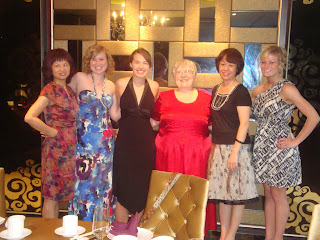
All of us with Peggy and Wei Ju. They were so great to us!!
Then came the emotional part of the night… goodbyes. How do you say goodbye to the people who had played such an integral role in getting us to China, who made our experience more than perfect, and who had become such dearly loved friends of ours? They have all been so great and so helpful. I wish that we never had to leave them. I would say that more than a few tears were shed.
Time for our last night’s sleep in Guangzhou……. So sad L
June 12th: Day with Hu Jing!!! (Rachel's Reflections)

Today we had our first relaxing morning of the trip. We didn’t have to be anywhere until noon! It was a well needed rest.
We met up with Hu Jing at noon for a day packed with fun!! It was a free day for us, so Hu Jing offered to show us around the city.

She took us first to the dragon boat races. This only happens once a year, and it is a VERY big deal. The Dragon Boat Festival goes on for 20 days, and it is comprised of multiple different events including the dragon boat races. This is just a simple competition between very ornate boats, but it drew a huge crowd! We could barely get our faces in to see what was going on.
Next stop was the Guangdong Museum. This museum is brand new, it just opened last year. It was such a cool looking building and the architecture was exquisite!


We first got to see the Chaozhou Woodcarving Art Exhibition. This form of art is famous for its richness and subtlety of details, delicate and elaborate designs, exquisite craftsmanship, and grand look. Some of the pieces were so intricate, yet so extravagant. They carved elaborate structures for things as miniscule as food containers, incense burners, and pillows.

Next was the Exhibition of Duan Inkstone. This inkstone was made in ancient Guangzhou and is purple in color, and smooth and moist in texture. Water was mixed with the stone and then used as ink. It developed from a functional object to an object for practical use and appreciation. These stones were intricately carved to perfection.
We also saw the selection of pottery and porcelain. China is considered the “Country of Porcelain” and it was clear as to why after seeing the beautiful displays of colorful porcelain and pottery.


The last exhibition was the Exhibition of Natural Resources in Guangdong. It had seven themes: Topography, resources, precious jades and stones, medicinal plants, wild animals living on land or in the sea, and ancient creatures.
I am so glad that Hu Jing took us to the museum. I feel that it was very beneficial for us to learn about the history of the Guangdong province. It helped me to gain an even greater appreciation for Guangzhou.
After the museum we headed to dinner and the opera J. On the way there, we walked through an amazing park with hundreds of different plants and flowers. It was very strange, however, because it was in the middle of all of the tallest skyscrapers in Guangzhou. There was such a huge contrast between the industrialization of the tall buildings and the serenity of the park.

Opera in the park was next on the agenda. What an unbelievable experience to have!! We got to see an opera in Cantonese! And we sat in the front row. Hu Jing translated the main points of the opera so we knew what was going on. It was so intriguing!
Saturday, July 23, 2011
June 11th: Cantonese and Baiyun Mountain (Rachel's Reflections)


Today was the second day of the Diabetes Conference. The featured speaker of the morning was from Hong Kong and was lecturing about self-monitoring of blood glucose. She began her lecture off in English, but switched to Cantonese about 10 minutes into it. So we got to hear a lot of Cantonese, but unfortunately could not understand any of it. It was still interesting to be a part of the conference.


We had heard that Baiyun Mountain was a must-see attraction in Guangzhou, so we decided to go climb it. This was our first adventure without a translator, and man did we feel lost!! I had definitely taken for granted our translators up until this point. Communication is hard without them! We took a taxi there because we could not figure out the bus system. We made it safe and sound!

The hike to the top of this mountain took a little under an hour. It was a good work out for our legs J The view from the top was incredible! At least what we could see of it… It was pretty cloudy and smoggy, so visibility was not great. Nevertheless, we got a great view of the city and of all of the beautiful greenery. It was worth the hike!
A young man approached us on the way down the hill and asked if we were American. He had learned English, and he was eager to practice it. How fortunate for us!! He was very intelligent and fun to talk to. He helped us figure out how to get home, so we boarded the bus (much cheaper than a taxi.. only 2 Yuan, which is approximately 30 cents) and headed back to Jinan University!

Anja, Laurelyn, and I met Jenny, Joy, and Sampson (Jenny’s boyfriend) for dinner. We were excited to see them again! We hadn’t seen Joy or Sampson since our first day in Guangzhou. For dinner, we went to the little noodle restaurant that Rachel had brought us to at the beginning of our trip. We couldn’t imagine not eating there again before we left! It was delicious, and super cheap! Jenny, Joy, and Sampson really enjoyed it too. We had a great time with them, but sadly this marked the beginning of our goodbyes. L We have grown so close to so many people here. I never want to leave them! I hate saying goodbye. I know I will see them again someday though.
June 10th: The Beautiful City of Zhuhai! (Rachel's Reflections)


Zhuhai City, also known as the Harbor City, is located at the southern tip of the Pearl River Delta. It is a beautiful garden-like coastal city with 146 islands off of the coast. We departed early in the morning with Eva and Lisa to spend the day in this paradise city.
Zhuhai has a sister hospital to the Affiliated Hospital at Jinan University, so they main purpose of our visit was to see the hospital and learn more about it. The People’s Hospital of Zhuhai as 2 campuses with over 10 buildings! It is a very large hospital. They are in the process of undergoing a project to improve patient care and patient satisfaction. They were very excited about the results that they were getting and it was encouraging to see such a large emphasis on maximizing patient experience.
The hospital staff was very excited to have us visiting today. We got to meet with the President of the hospital, the Vice President of the hospital, and the director of nursing at the hospital. I felt very honored that they all took time out of their days to meet with us. The President gave us a presentation about the hospital and the changes that they have been making. It was very interesting!

After this meeting we were able to tour the hospital. We got to tour many different departments and meet many nurses during our tour. Their hospital is very, very nice. I am glad that I was able to experience this hospital as well as the hospital in Guangzhou just so that I could get a better overall idea of healthcare in China.
The Zhuhai Hospital had a very slick system for their out-patient department. I was very intrigued by it. The patients each have their own card that has all of their information on it: medical history, immunization records, anything that has ever been recorded in their charts. When they came to check in they would simply swipe their card and it would bring up all of their information. It was a very efficient system, and something that I think would work very well in the United States.

We had lunch with everybody that we had met that day at the hospital. They took us to a restaurant that was in a ship on the bay! It was so cool! We once again had a private room with huge windows overlooking the sea and the city line… Amazing! They truly spoil us here. I do not think that I have met a single person that is not downright hospitable and respectful. They are great!
Before we departed back to Guangzhou, we visited the “Fish Woman.” She is a very important attraction in Zhuhai. She almost reminded me of the Statue of Liberty. It was a big sculpture of a mermaid that sat off the coast in the bay. The sculpture itself is a landmark of Zhuhai and is based on a local folk tale.
It was a long day pack with fun and good company, but it was time to head back to Guangzhou. Goodbye Zhuhai!!
June 9th: Diabetes Conference, ICU, and Goodbye Juyan (Rachel's Reflections)


Today was the start of a 3 day Diabetes Conference that the hospital was hosting. We went to the welcome ceremony in the morning where Cathy was introduced as the featured guest speaker! I felt like a proud mother (or in this case a proud student) watching her sit up front with all the other big name speakers.

The Diabetes conference

See Cathy's name! She's Famous!
 After the welcome ceremony, we got to spend some time in the ICU, Cathy’s specialty area. The ICU at the Jinan Hospital is only 6 years old, so everything was very up to date and very clean. The nurses in the ICU were extremely interested to hear about the way that we ran our ICU’s in the United States and were also very eager to tell us about their ICU. We had some really great discussions with them and got to learn a lot about Intensive Care Nursing.
While we were in the ICU, we witnessed CPR and defibrillation. This is not necessarily an ideal situation, but it was a good learning experience for Anja and I as nursing students. We had never seen a code before, and it was cool to see the nurses in action. It definitely took a lot of skill and agility; you must be on top of your game at all times while working in the ICU.

A dialysis machine. Each patient receiving dialysis had a dialysis specialist in the room with them throughout the whole treatment.

Most of the equipment they used in their ICU was shipped over from the United States

A gangrenous hand. This looked painful
Today is Juyan’s last day in Guangzhou L We had a final goodbye lunch with him today. I cannot believe that our time with him is already over. We met him on our first day here, but the past 2 weeks flew by! He has made this trip so incredible. It really would not have been the same without him. He showed us so much, took us to many places, taught us about Chinese culture, and acted as our own private translator. He was so great. I will always remember the fond memories we created with him.

Cathy spoke today at the conference on Diabetes Nurses in the United States. She did a really great job!! There were a lot of nurses there to hear what she had to say. Lisa translated for her and everyone seemed to get a lot out of it.
Today was also our last day at Taian Midle School. Things are starting to wrap up, and I feel like we just got here. I am not ready to leave yet! I guess we still have 6 days before we depart, but that is not long enough! I never want to leave.
 The students at Taian Middle School were excited to have us back again. Our goal for the day was to have a discussion with them about the changes they had been making in their lives since our previous time with them, and also to give them the survey once more to get some concrete data measuring the impact our education has had on the students.
It was very rewarding to hear the students talk about what they had taken away from our presentation. Many talked about how they exercised more, ate more vegetables, limited their screen time, and cut down on their fast food intake. How cool to be able to see firsthand the benefits of healthy living!!
Subscribe to:
Posts (Atom)